
From India to Miami
From India.Arie to Young Miami, a familiar cultural debate continues its journey across generations.

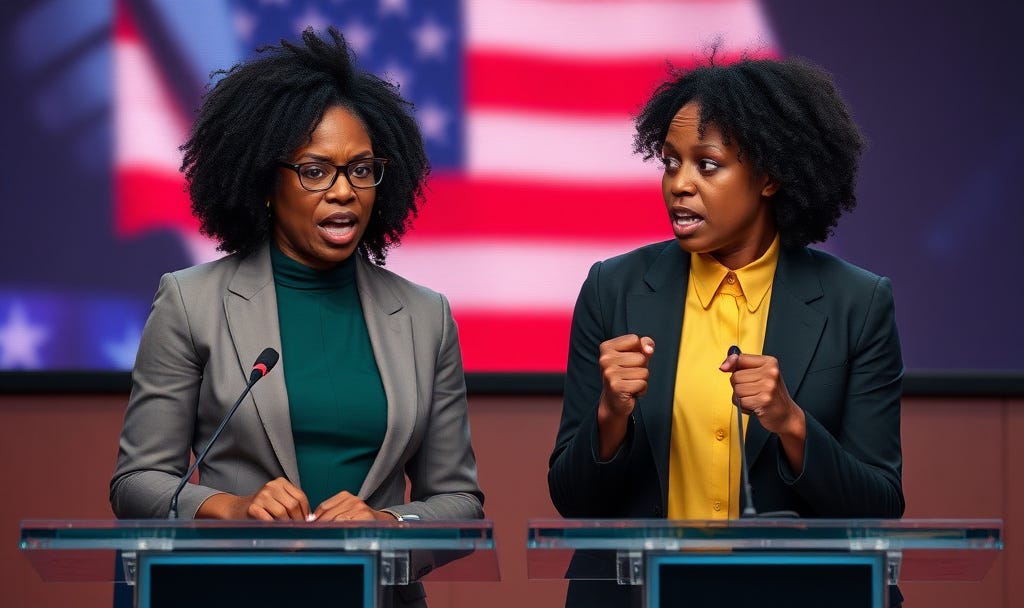
The recent “controversy” between Neo-Soul artist India.Arie and rapper Young Miami has brought the debate up of what is art and artist responsibility. When India.Arie publicly questioned the messages promoted by Young Miami’s song, “Spend That”, the debate quickly became bigger than two artists. It reopened one of culture’s oldest questions: Does art simply reflect society - or does it help shape it?
Art has always resisted simple definition, making debates about artistic responsibility equally subjective. From my perspective, this has always been the case – even in the times of limited content and accessibility. Acts like Amos ‘n’ Andy, along with performers like Stepin Fetchit, whose persona popularized degrading racial stereotypes, were once considered entertainment but have since been criticized for their portrayals of Black Americans. Conversely, entertainers like Lena Horne, Harry Belafonte, Dorothy Dandridge, Sidney Poitier – just to name a few who largely went out of their way to avoid stereotypical depictions of Black Americans in their work.
Fast forward to the advent of rap music, when groups like 2 Live Crew and N.W.A. challenged and broke boundaries with albums, songs, and lyrics that led critics to question whether rap should receive First Amendment protection. Activists like C. Delores Tucker led the fight against rap lyrics deemed misogynistic and in 1985, Tipper Gore co-founded the Parents Music Resource Center (PMRC) with Sally Nevius, Pam Howar, and Susan Baker – which led the push for explicit content labels on physical music releases.
Even debates over traditionally romantic genres like R&B have shifted toward questions of artistic responsibility rather than simply musical style. Keith Sweat recently argued that modern R&B lost its romantic essence by embracing profanity and adopting the sensibilities of rap.
India.Arie questioned what messages artists have a responsibility to promote, while Young Miami has defended making music that reflects her own experiences and audience. Their exchange revived a question every generation eventually asks.
What makes this conversation so compelling is that it rarely stays confined to the art itself. It almost always becomes a conversation about culture, influence, and values. We often ask whether art imitates life or whether life imitates art, but the truth is they exist in a constant exchange. Artists create from the world around them, and in turn, their creations help shape how people see themselves and each other.
That reality makes the question of responsibility far more nuanced than simply saying artists should censor themselves or that audiences should simply “turn it off.” Both positions oversimplify an issue that has never been simple.
The pattern suggests we rarely debate art because it is merely offensive. We debate it because we recognize its ability to shape culture, ideas, attitudes, and behaviors even while disagreeing over how much influence it truly has. Jazz was once condemned as immoral. Rock and roll was accused of corrupting America’s youth. Rap became the center of political hearings and public outrage. Even now, social media has accelerated the conversation by giving every lyric, performance, and interview an immediate audience and an equally immediate response. The platform has changed, but the debate has remained remarkably consistent.
Perhaps what has changed most is our expectation of artists themselves. We no longer view entertainers solely as performers. They are expected to be cultural leaders, activists, role models, entrepreneurs, and public intellectuals all at once. Yet many artists have maintained that their obligation begins and ends with authentic expression, not public instruction.
That raises another important distinction: expression is not necessarily endorsement. An artist can depict violence, misogyny, addiction, or moral failure without advocating for those things. Literature has done so for centuries. Films routinely portray flawed protagonists without suggesting their behavior should be emulated. Unlike a novel or film that many people experience once, songs often become part of daily routines, social gatherings, celebrations, workouts, and personal identity. According to the International Federation of the Phonographic Industry (IFPI), the average listener spends nearly three hours a day engaging with music. That level of repeated exposure gives music a unique cultural reach. It is consumed repeatedly, quoted, celebrated, and internalized in ways that other forms of art sometimes are not. Music also differs because it is often tied to identity, community, and personal memory. That difference is worth acknowledging without assuming that music alone bears responsibility for society’s shortcomings.
Likewise, audiences cannot be absolved of responsibility simply because content is available. Consumers have always exercised choice, whether by purchasing an album, attending a concert, changing the channel, or supporting an artist with their dollars. Every generation decides what becomes commercially successful. Markets respond to demand just as much as artists respond to opportunity.
The more difficult question may not be whether artists have responsibility, but whether all responsibility should rest with them. Parents, educators, faith communities, media companies, streaming platforms, record labels, and consumers all participate in shaping culture. To isolate one participant while ignoring the others is to misunderstand how influence actually works.
Artists may not have an obligation to create morally uplifting work, but they should expect public criticism for what they choose to create. Freedom of expression has always coexisted with public scrutiny and accountability.
Young Miami has the freedom to record and release the music she desires, and her audience has the same freedom to consume it or not. Her music reflects her experiences, her audience, and the lane she has chosen to occupy. Just as Keith Sweat believes R&B should embody romance and sensuality, Young Miami represents one segment of a generation of artists who prioritize authenticity over convention. Neither perspective invalidates the other simply because they exist in opposition.
In her career, India.Arie has made music promoting love for self and others, Black empowerment, embracing our inner and outer beauty, and celebrating worthiness and becoming. From my perspective, her criticism runs deeper than Young Miami and one song. It comes not from a place of hate, but from a concern born out of love for her people and a strong belief of the power of music.
That is why the conversation between India.Arie and Young Miami feels familiar rather than revolutionary. It echoes the same debates that surrounded Amos ‘n’ Andy, Stepin Fetchit, 2 Live Crew, N.W.A., and countless others before them. The names change. The genres change. The technology changes. But society continues asking the same fundamental question: Should art simply reflect who we are and what we do, or should it challenge us to become something better?
Art has never simply reflected society, nor has it ever single-handedly transformed it. It exists in constant conversation with the culture that creates it. That conversation is precisely why debates over artistic responsibility continue - and why they probably always will.